
Summary: Another message from the bog that is my mind to explain to anybody curious about how publishing works or getting their writing out there on what it’s really like with tips for how to tighten your work sprinkled in-between.
Alright, alright, alright.
I haven’t written one of these bastards in a while since I explained my thought process with character creation, so, let’s get in the bag together and talk some shop, yeah? The goal here is to inspire you in your own writing journey; ideally, you too are a romance/erotica writer like I am, but really, I aim to inspire anybody who does fiction regardless of your skill level. So, let’s begin!
Why the fuck are YOU qualified to tell me any of this?
Good question. I’ve got about as much sanity as Bitsy from Legends of Avantis and the humor of a 12-year-old discovering TikTok for the first time so I don’t blame you for being weary of me.

Just kidding. I have a MFA in creative writing from Spalding University. I also minored in creative writing back in my undergrad before that. And then (yes, hold on, there’s a part 3), I was writing weird crossover situations in my little $2 notebooks since I was 10. Writing’s just one of those things I’ve been passionate about my whole life and, even if I make no money off of it, I’d do it for free until I die.
Overall, I’ve got a decade’s worth of experience in proofreading and editing. I’ve done selections for literary journals. I help my co-horts and friends edit their work all the time and they’ve turned around to get it listed in major magazines. Don’t care if you’re a beginner or Stephen fucking King, if you want some feedback, I’m always happy to help others learn how to get into this craft.
Now that I got the boring stuff out of the way, how about we begin? Let’s start here. . .
Alright, Fine. But Uh, How Can I Tell a Story that ‘Sells’?
Trick question. There is no answer I can hope to give that would appease you because a ‘good’ story can mean anything, so, let me use myself as an example to try and demonstrate. Here’s two of my favorite authors to exist writing a story that achieved recognizable success with the same characters:
Book 1: An epic-length project that chronicled Lucifer’s exile from Heaven on to how he forged Hell. He angsts about how he is shunned yet embraces it in the same breath as he learns how to run the realm.
Book 2: A novella where Lucifer sends a letter to God asking Him to reconsider how feeble the humans are in the hopes that Lucifer can just kill them. Michael ends up responding, creating a “dialogue” between two of the oldest spirits in the Bible.
What’s the difference, you’re asking? Not much. Paradise Lost by John Miller and Dialogues With the Devil by Taylor Caldwell both do the heavy lifting of introducing you to famous entities in The Bible in the hopes of luring you into their wild ride. Where they differ is that Milton was already entrenched in literary arts; since his youth, his core focus was on learning multiple languages like Latin, Hebrew, and Greek while simultaneously studying from previous classics that preceded him (see “The Inferno”) in an effort to inform his masterpiece. Compare this to Caldwell’s more “informal” approach, which is just a fancy way of saying ‘she didn’t go to college until she was much older.’ Caldwell went on to produce a series of quasi-religious books that explored the philosophical nature of religion’s relationship to man, but this one in particular decided to take the traditional conflict of ‘ego’ versus ‘spirit’ to be more homoerotic in nature.
Whatever you take away from my example at the end of the day, at least know this: whether you’re an elite like Milton who happens to go blind during the creation of your masterpiece, or somebody like Caldwell who had to scrape by to afford a Bachelor’s degree. . .you are an artist. Read, ask, and create. Then do that again, and again, and again. Do it so many times you get sick of it. I promise, by the time you think you’re on your last straw, that is the masterpiece you needed to make.
And How Exactly Do You Know That It’ll Work Out, MRS. MFA?
So, I went to a writer’s conference recently in the hopes that I’d be able to find a publisher for Doll Parts while it’s in progress. It was my first time throwing a pitch out since a lot of my previous writing history involves poetry, and it went really well! The agent was supportive, said they really like my work and felt I knew my targeted audience well. . .
. . .until I found out that almost no agent will take incomplete work from a debut author. Now, I know that sounds like a total ‘duh’ moment and it is, okay, trust me, I felt like a bird smacking a window because my near-sighted self couldn’t see it coming.
Don’t get me wrong, rejection is normal and inevitable. When I did poetry, the odds I’d see a ‘yes’ from a ‘Top 100’ poetry magazine were so low I probably stood a better chance of getting struck by lightning. Even now, when I post online, somebody out there can ‘reject’ what I’m doing by throwing the metaphorical tomato at me and booing me off the stage. That’s just the life of being a writer, I’m afraid.
No, what I want you to think about is what you really want when you’re about to share these things with the world. Are you trying to be traditionally published as a fiction author? Because if so, you have to think about the length and scope of your project. Writing takes time. Getting feedback, that takes time. And even if you’ve got a strong draft, well, you may have to whip it up in the lab again and again until you get that final nod, all for you to then need to enter a series of meetings where you and the agent hash out ‘hey, how does this summary sound’ and ‘this cover artist, do you like how its presented?’ Everything about publishing is the optics of your book, and if that book doesn’t hit the target with a perfect bullseye, your odds tank just like that.
Still, that does NOT mean there’s not an audience for you! I myself decided to abandon the traditional route and just write what makes me happy. Doing that has resulted in a small but sizeable audience that has been incredibly supportive; I’ve made new friends along the way and have curated my own ‘world’ with the help of multiple artists so even if I never see a single publishing firm in my life, at least I know my work exists beyond me.

Regardless of your preference for path, I want to end this section by encouraging you to read this article by alicesparklykat. I read it a while ago while I was finishing my MFA feeling inspired with the chance to pursue a path in case what I was doing wouldn’t work out (which it did not, that unfinished draft of poems stares at me, mocking me, to this very day). Then, I read it again last week because I was frustrated that even with what I consider my strongest work, I’m not meeting industry-standard chops. For anybody who’s under 35 or spent too much damn time trying to chase after the illusive goal of a “real” book, I really encourage you to just say ‘fuck it, I ball’ and post your shit. Don’t wait for approval, make your own. And that, that is how you know it’ll work out.
Let’s Say You’re Starting Out! Where the Fuck Do You Start?
Before you fret about things like plot, structure, a rising action, blah, blah, blah. . .my first piece of advice is to use your voice. Some of the best things I’ve ever heard or read despite their lack of polishing is that they said it with their chest. This is the same technique I used in some of my earliest drafts despite not having as much formal training with fiction writing.
Now, how do you go about picking your voice? Well, we can get lost in the weeds and discuss things like your subject matter, your target audience, etc. . .or, we can just cut to the chase and I’ll tell you how I decided on my voice in the hopes of making it easier for you to decide.
As you know, I write about The Bible. Well, the Bible is a giant parable infused with authors spanning multiple cultures over 1,200 years. How can I make you (the reader) find what I (the writer), interesting yet educational considering the tone the Bible traditionally takes on? I make it weird.
And that’s how you get a buy-in. If you find what I’m doing absurd, great! I made it absurd on purpose because I want it to come off funny because I understand The Bible confers a degree of seriousness that is hard to overcome if you have any sort of religious guilt or trauma. If I wrote everything I’ve done like I was a preacher, my audience would be far and fewer between.
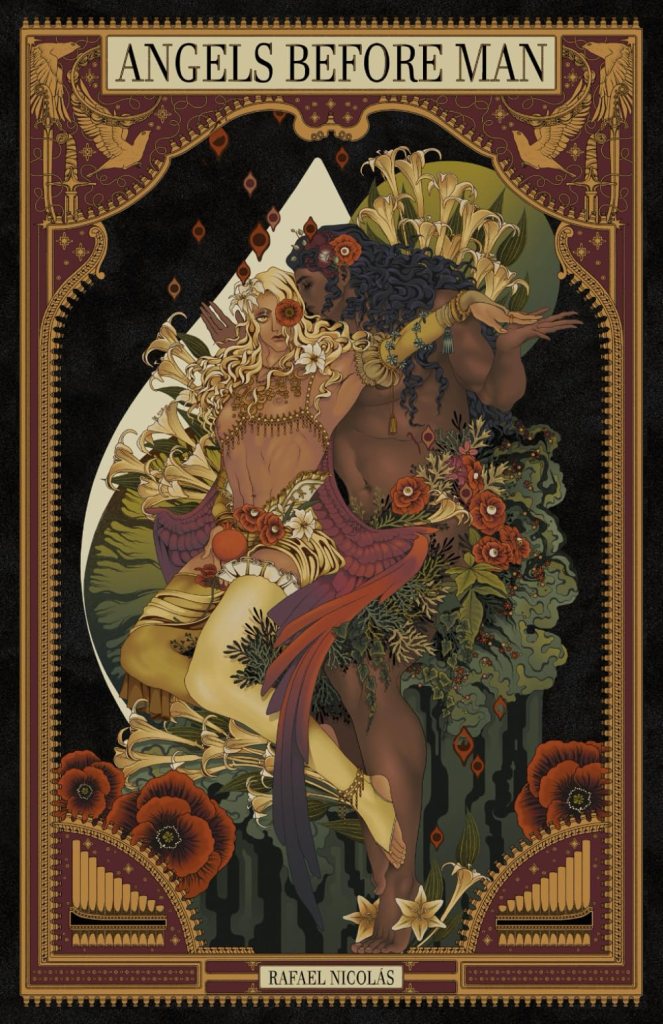
For yourself, though, I don’t mean to say you need to be wonky like me to get the job done. I’ve read works that are deathly serious and they still get a massive audience because they chose a voice that hooks you. A good example I haven’t mentioned yet is Rafael Nicholas’ book, “Angels Before Man,” which has a more lyrical prose to it that makes you think you signed up for something sweet when you didn’t. Even in the most brutal of moments, it feels like you’re reading how to water a plant; in that way, it delivers its message with such brutality that you almost don’t register it until it’s too late.
TL;DR: Choose how you want to express yourself. If you want comedy, be comedic! If you want a tragedy, be dark. Lean fully into the way you want the reader to hear the voices in their head if you’re going to write, and don’t shy away from it. Genre fiction is especially forgiving about this since you’re already catering to a specific audience; if I can make you think it’s normal that the Holy Archangel Michael has a potty mouth, it’s only because almost everybody else does.
Writing is Like a Garden: You Need a Few Tools to Get the Job Done
Wise man once said fiction is about putting your words in the best order possible. That means even if you think your writing is mediocre, the way you’ve phrased something can mean the difference between another story floating off in space versus a story that sticks in somebody’s mind. Here’s an example from a (non) Bible related book called “Their Eyes Were Watching God” by Zora Neale Hurston:
“They begged Janie to stay on with them and she had stayed a few weeks to keep them from feeling bad. But the muck meant Tea Cake and Tea Cake wasn’t there, [so] it was just a great expanse of black mud.” – Pg. 182
Without telling you a single word about this book, you’ve likely grasped that the main character has lost somebody important to her, right? But, if I were to tweak the way this whole sentence started out, would it leave the same impact? Let’s try it:
“Janie stared off at the great expanse of black mud, thinking about Tea Cake. Well, Tea Cake wasn’t there no more, so all she had was the company of her neighbors begging her to help with fixing up this mess the hurricane left.”
Can you feel a difference there? I think what I wrote is still ‘good,’ but, obscuring Tea Cake’s loss halfway through the paragraph means you get smacked with the weight of grief Janie is feeling more than if I dump it on you from the beginning, so, think carefully about how you want to depict something for the times you want it to gut punch the reader.
Of course, word order isn’t the only way to achieve this. I’m going to now throw at you a few quick terms to experiment with so you’ll feel encouraged to try it out for yourself. They’re easy things to use whether you’re starting from scratch or stuck on the 10th version of your draft, so, the next few sections will be devoted strictly to each concept and how I employ it in order to create the things I do. Let’s begin:
- Repeat, Repeat, Repeat
They say repetition is a bad thing. . .if you make it a bad thing. Since I’m using The Bible as my vehicle of expression, I’ve noticed that it repeats itself a lot, trying to express to its readers key moral lessons by saying it over and over again. In order to replicate that in real time, I do the same thing. Often, I’ll repeat a name, a number, or a motif across multiple stories so they all tie in even if I spread them out over different ‘timelines.’ Observe my repetition of a popular artwork in two very different timelines:
The antechamber was a humble waiting room bathed in the dim glow of candlelight. The only thing on the wall was a singular painting, the likes of which changed for every pair He initiated. For them, it was –
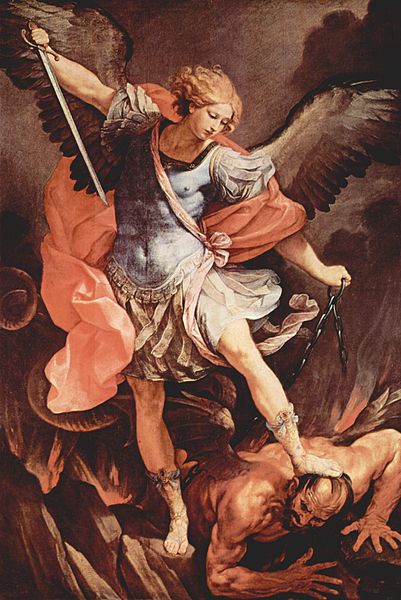
“Saint Michael slays the Dragon by Guido Reni.” Yahweh doesn’t even bother looking behind Him. He just knew that’s what they chose. “In the name of Me, you two could not be more topical.” – The Silver Path to Redemption
Versus this one:
Lucifer hums his appreciation. Before he takes a looky-look down the hallway, he would address the most hilarious thing of all [in the house]: the painting above the chair. It was the only one in the room so it commanded the center of attention, and what would it be if not –
“Saint Michael Slays the Dragon by Gudio Reni.”
Lucifer grins now, hand beneath his chin as he tilts his head. “Y’know, I almost considered gettin’ this one instead of The Fall of the Rebel Angels when I first moved into the office.” – Doll Parts
Same thing, right? I introduce a concept – Guido Reni – and use it in two wildly different contexts. It may sound, ahem, excuse the pun – “repetitive” to bring it up so many times, but I do that because the group of people who want to read Hazbin Hotel may not be the same group of people who read my original content. Regardless, I want the concept of Michael ‘slaying’ Lucifer to stick because that is an integral concept to their characters.
When it comes to writing, especially with something like romance or erotica, the point is to make things stick for the reader that matter to the plot. Remember, this is Checklov’s rule: if I mention a gun once, it’s just a gun. If I mention it twice, you’re going to start thinking about the gun. By the time I pull the trigger, you’ll know it’s a gun because I made it a gun and I want you to constantly think about the gun. Make your reader think about the gun until it drives them mad, and you’ll find they want to keep turning the page.
- Juxtaposition: Make Things Flip-Flop
Juxtaposition is a funny word, one I really enjoy. It just basically means ‘compare two unlike things to each other in a poetic way.’ You can think of this like a peanut butter and jelly sandwich, the Yin-Yang symbol, light and dark, it really doesn’t matter. The point of this exercise is to create tension in your story (in the absence of an active conflict like a fist fight or somebody dying) by highlighting how two seemingly unlike things have more in common than we think. Here comes an example of how I achieve that:
“Well hello there, miss.”
Lucifer now begins, tilting his wide-brim hat down with one hand while the other stays obscured behind his back. He’d then take it off and turn to the side so his back is leaning on Michael’s doorway; the first thing the blonde notices besides that handsome smile and the nicely-braided hair is him wearing a silk blue shirt with brown slacks held up by suspenders in a matching color, the hem flowing so nice and loose he looked like he swayed with the wind. “Hope I’m not intrudin’ or anything but I uh, noticed you walkin’ around the other day and thought you were real fine. Mind if I ask you out on a date?”
What an absolute dork, Michael thinks, though he obviously doesn’t match his mental since all his tanned skin is flushing. “Funny you should ask. I was just wishing a handsome stranger like yourself would come and talk to me some time.”
Lucifer smiles in earnest, gaze twinkling as he takes the hat off. His gaze then drinks in this beaut of a birdie before him, admiring the delicate attention Michael paid to curling his hair as well as the spotless romper that screamed Rosie the Riveter. “Then won’t I be motherfucking damned. Now I’m worried I didn’t dress up right for the occasion with a girl as fine as you.”
The context here is that I flip the script on who you’re supposed to interpret as ‘The Devil’ versus ‘The Angel.’ Lucifer wears a lot of blue to show his initial commitment to the path of ‘good,’ whereas Michael ties red into his otherwise white outfit as a way to show he’s got some ‘bad’ in him. The point is to create a metaphorical dialogue between two characters on opposite sides of the track so you can start to see how they’re more similar than different.
Anyway, when you use this technique, what you achieve between your primary couple is conflict of a different kind. It’s easy with romance in particular to rely on miscommunication as a technique to generate drama, but you don’t need to do that to keep a reader interested. Really, you keep the reader beside you by creating a sort of internal tension that sparks between them, one that makes the characters want to learn more about each other and the reader want to learn more about them. Real life works like this, too; my closest friends do things so differently than I do that it baffles my mind, yet we all share a common background in being neurodivergent that I’m learning things from them all the time. It’s fun, it’s less complicated than “oh, I overheard you say – “ so just give it a try and see how you feel about your writing after!
- Chekhov’s Gun: On Metaphor and When to Pull the Trigger
Ah, metaphors. Bet you’ve heard enough about those things that I’d sound like your Creative Writing 101 teacher if I bonk you over the head with it again, right? Yeah, definitely. I won’t beat a dead horse too hard, but, let me explain why I’m bringing this one up again despite your familiarity with it:
Using a metaphor (or a simile, which is the difference between being direct and indirect), is the #1 tool any writer needs to make their work pop. Of course, there are such a thing as cliches’; I can compare ‘any name to a rose’ and it will sound nice on paper but bore you to death when you read it, right? But not all metaphors are created equal. A good metaphor is going to make you want to bite your teeth into the book the way you tear apart a sandwich.
(See what I did there? I almost want to eat the pages myself with that one).
Okay, that was a tangent. In reality, a powerful metaphor will tie the theme of your project in with a feeling the reader can identify with despite not having ever lived in that time or place. In particular, a lot of romance and erotica readers want to be able to identify with either being the pursued or doing the pursuing in a way that grips them; it doesn’t have to be ‘healthy,’ necessarily, but it has to be compelling in a way that you get a reader to nod their head and go ‘yeah, I could see why that shit would happen’ if said reader were thrust upon a situation. Here’s an example:
Disguises hide lies real well, don’t they?
Lucifer thinks this time around with the hint of a smile. The two bags of brown, paper bags that he cradles like twin infants close to his chest begin to weigh his arms down and his next thought is ‘I like this,’ ‘I want this,’ ‘her, is she the one?’ To this end, the detective will seek the answer he’s looking for by tapping the door with his foot.
In this instance, I’ve raised the imagery of Lucifer cradling grocery bags like ‘twins’ as a metaphor (and foreshadowing, if I’m being frank) as a way to signal to you that there is a possibility they’re considering adopting children. Again I say, this is the rule about Chekhov’s gun: I show it to you once, well, maybe you can ignore it. I do it twice? Start guessing. . .and by the time I show it to you a third time, I had better have fired the damn gun so I don’t look like I’m a liar by faking you out.
One other thing to note about making a ‘good’ metaphor or simile is to default to the senses. What I mean by that is: make it feel real. Obviously grocery bags are nothing like infants, are they? But if the heft of the weight and the desire to ‘start a family’ are clear themes for Lucifer as a character, then even you start to trick yourself into believing that maybe, just maybe, those are a set of motherfuckin’ babies.
Now, to tie it all together. . .
I’ll try not to bore you to death much longer, I promise! If you’ve read most of this to the end, well, I really appreciate that. If you just skimmed, great! And, if you even clicked on this just to add to my hit counter, hey, I made ‘ya look.
Just kidding. Thank you for getting this far. Here’s my ‘conclusion’ for everything I’ve been trying to express to you with one final example using my story as the sacrificial lamb:
Lucifer told Michael when they started dating that he grew up as a ‘good kid in a mad city.’ Later on when they agree they should cut the crap and think about living together, Michael confronts Lucifer about more details. Lucifer usually uses his wit and goofy humor to deflect from acknowledging from painful topics, so by the time he breaks down and actually tells Michael everything, his past means something because he’s choosing to be vulnerable for once.
Okay, that one was a summarization, but the point here is that I use the early chapters of my work to be ‘disarming’ on purpose. Lucifer makes a joke about finding his dad dead like it’s casual because it’s painful. By the time he actually expresses how painful that is, it should show how much more he a) is changing as a character and b) how his relationship with Michael is progressing. Every character needs to show at least one small degree of change whether it’s for better or for worse, or else you get a story that doesn’t move. And, well, I think even if you’re brand new and just heard of the word ‘fiction,’ you know the #1 rule of a story: things change. Without that, how am I supposed to know when the story’s going to end?
And that concludes today’s ‘workshop’ talk with you folks. I know this one was longer than my first but, I enjoy explaining my thought process behind what I’m doing so you can see the intention I carry behind my words. By the time you even see one of my posts online (yes, even with all of my goblin-y typos), I spent hours spinning the block in my mind thinking about who does what, why, and how it’s going to move a story forward. May this also help you craft your next project and keep your head held up high ❤️.
 Real Gods Require Blood
Leave a comment